

Sports Injury Doctor in St. Petersburg, FL
See a Sports Injury Doctor in St. Petersburg, a Doctor of Chiropractic Who Gives You a Straight Answer
5-Star Rated | Same-Day Visits | Return-to-Sport Plans
New Patient Discount:
Comprehensive Exam + 1st Session + Personal Treatment Plan
Why Choose Us
Why athletes who want a straight answer trust ELITE CHIROCARE


Exam first. Dr. Raad tests the injury instead of guessing from the spot that hurts
A straight answer on whether your injury warrants imaging or a specialist opinion
What you respond to stays in the plan. What you do not respond to comes out
Specific homework between visits, because tendon tissue adapts to loading, not to rest
Offering dry needling and shockwave therapy for stubborn tendon and muscle problems
State of the art equipment and modern techniques for athletic injuries
Same-day appointment availability, which matters when you tweaked something Saturday
Verified 5-star Google rating from real local patients
No pressure to commit to a long-term plan
Central St. Petersburg location, so an appointment fits around a training block

What We Offer
What we treat for sports injuries in St. Petersburg
Acute ankle, knee and wrist sprains, including ones that swell fast and hide the damage
Muscle strains and pulls in the hamstrings, calves, hip flexors, quads and groin
Overuse injuries from running, lifting, racquet sports, golf, pickleball and swimming
Tendon pain that began as a warm-up ache and now shows up at rest or the morning after
Joint pain that caps training volume: knees on descents, hips on long runs, elbows on a backswing
Burning, dead-leg or pins-and-needles symptoms that outlast the session that caused them
Season-after-season recurrences that quiet with rest and return at the same training load
Compensation chains, like a stiff ankle driving knee pain or a locked hip behind hamstring strains
Stiffness and lost range of motion limiting your technique and output more than causing pain
Returning to sport after an injury, including the hardest part, deciding when it is safe
A loaded examination: we watch you move the injured part under the demand that hurts
Chiropractic adjustment and joint mobilization for the restricted segments found on your exam
Soft tissue treatment, offering dry needling and shockwave therapy for persistent tendon problems
Graded rehab loading and corrective exercise, with a return-to-training progression you take home
Meet your chiropractor
Dr. Raad, DC, MBA, MA

The question almost nobody gets answered is the one that matters: is this the kind of injury that quiets down if you manage it sensibly, or the kind that becomes a two-year problem because you kept training on it? Dr. Raad has built his practice around answering that early. He has treated the ankle that rolled in a league game, the shin that hurts a mile into every run, the elbow that only complains through a backswing, and the hamstring that has now failed three times in the same spot. In every one of those cases the outcome was set long before anyone chose a technique. It was set the day somebody either identified the right tissue or did not, and then a training block got spent accordingly.
Guessing is the expensive part. Lateral hip pain gets called bursitis when the findings point at a gluteal tendon being asked for more than it can currently give. Shin pain gets called shin splints when the history and the palpation findings say it deserves an image before anyone loads it again. A hamstring that keeps failing at the same point is often not a hamstring problem at all. A label takes a second to apply and a long stretch of training to disprove. The first visit is where Dr. Raad declines the label and goes looking for the finding underneath it. If what he finds sits outside what conservative care should be handling, he says so plainly and refers you for imaging or a surgical opinion.
A case that stalls is information, and he treats it as information. Sport makes this harder than it sounds, because you keep using the injured part, so a plan that was correct in week one can be wrong by week three. When the markers set at the exam have not moved, the working diagnosis gets questioned before your effort does. Something comes out of the plan, something goes in, and occasionally the honest answer is that the case needs a set of eyes it has not had yet. By week six the plan should not look like week one.
Athletes make more decisions about an injury than any clinician does. Whether to run on it, whether to load it, whether tomorrow's soreness is progress or damage: those calls get made all week without supervision, and together they matter more than anything that happens on a treatment table. So Dr. Raad will not hand you an instruction you do not understand the reason for. He wants you able to read your own injury well enough to know when to push and when to stop, and that includes an honest timeline, because a tendon problem that is going to take months is far better known at the start than discovered partway through.
Dr. Raad is a Doctor of Chiropractic with a background in human physiology, and he also holds an MBA and an MA. He is not a medical doctor and not a surgeon, and he is direct with patients about where that line sits. Sports injuries often respond well to conservative care, and the ones that do not need to be identified early and sent to the right specialist. The overlap he works in is orthopedic and sport injuries that turn out to involve a disc or a nerve.
PATIENT Reviews


Our Approach
Naming the Injury Before Treating It
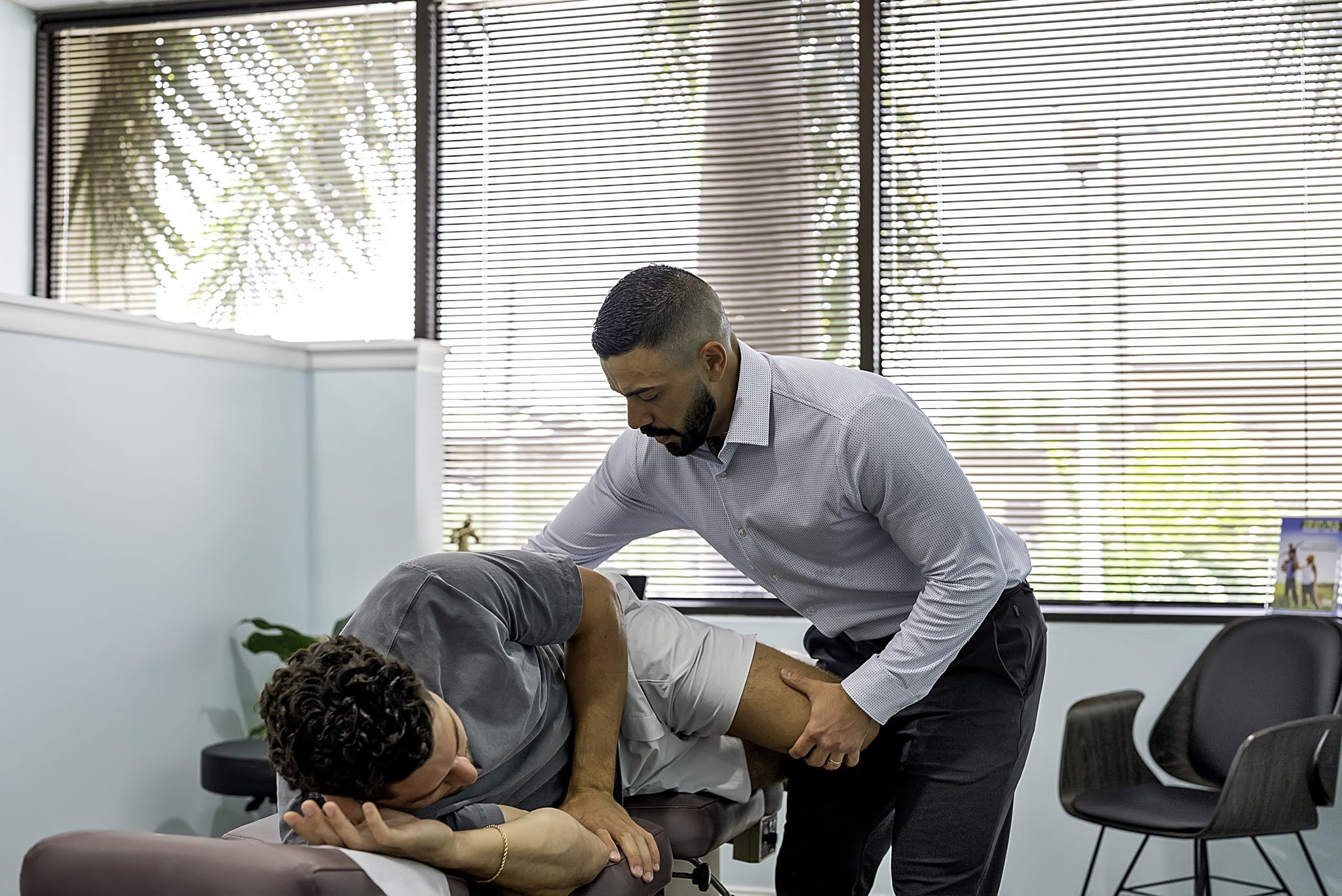
The hardest part of a sports injury is rarely the treatment. It is the identification. Pain location is a weak clue, because a knee can hurt because of the knee, the hip above it or the foot below it, and a tendon under too much load can feel identical to a joint that is restricted. So the first visit is an examination, not a treatment session with a label attached afterward. Dr. Raad runs orthopedic stress tests on the joint in question, screens neurologically when there is numbness, tingling, weakness or pain that travels, and watches you load the area to see what reproduces the symptom. If the findings call for an image or a specialist's read before anyone puts a hand on you, that is what gets recommended.

A Plan That Has to Keep Earning Its Place
Your plan is a working hypothesis, and in sport it gets tested constantly because you keep using the injured part. Dr. Raad treats it that way. Objective markers from your exam get rechecked at intervals, and the results drive what happens next. If range of motion opened up but the tendon is still painful under load, the plan shifts toward loading and shockwave therapy rather than more mobilization. If a nerve finding has not improved, that changes the conversation entirely and may mean imaging. Treatments that are producing results stay. Treatments that are not get removed, not repeated. That is also why there is no pressure here to sign up for a long block of visits in advance: the right number is the number your response to care supports.

The Part of Recovery That Happens in Your Training Week
Healing connective tissue needs a stimulus, and that stimulus happens in your week, not in the clinic. This is where a lot of sports injuries are either resolved or made chronic. You will leave with a small number of specific things to do, with reps, frequency and a clear description of what the right amount of discomfort feels like, along with a short list of what to stop doing for now and when it comes back. You will also get the decision rules you need when something does not go to plan: what level of soreness is expected, what swelling the next morning means, and which symptoms are a reason to call (727) 498-6027 rather than push through the next session.

Sports Injury Doctor in St. Petersburg, FL
Hurt yourself training and the instinct is to look for a sports medicine physician or an orthopedist. Sometimes that is right. Orthopedic surgery is the destination for fractures, significant ligament tears, dislocations, joints with genuine mechanical instability, and anything that has to be seen from the inside. But the injuries that sideline runners, lifters, golfers, racquet and pickleball players in St. Petersburg often fall into a different category: tendon overload, a restricted joint, a muscle strain, a movement pattern loading one structure far harder than it was built for, or a nerve being irritated somewhere along its path. Those need accurate identification first. The useful first step is not choosing a provider type. It is getting examined by someone who tests, and who will tell you early when your injury warrants imaging or a surgical opinion.
Acute injuries and overuse injuries run on two different clocks, and both of them punish waiting. With a fresh sprain or strain, swelling and guarding can mask how much was damaged, so a protective first week reads as recovery right up until the injury fails the first time you load it properly. With overuse, the clock is about tissue quality. A tendon that has only recently become irritated is often still reactive and responds well. The same tendon trained through for months changes character and takes longer to rehabilitate, whoever ends up treating it. An injury that flares, settles with rest and comes back at the same intensity is being rested below the level where it would adapt. Nerve symptoms are their own category: numbness, tingling or real weakness that persists is a reason to be seen promptly.
The address is 3637 4th St N, St. Petersburg, FL 33704, central enough that the drive in works from most of Pinellas County and from the Tampa Bay side. Same-day appointments are often there when you need one, which is the whole point when something happened yesterday and there is a race, a match or a lifting cycle you are trying to protect. The next step is one visit. You get a real examination, a clear explanation of what the problem is, an honest answer about whether conservative care is the right route or whether you need an image or a specialist opinion, and a plan you can follow between appointments. You can reserve the new patient visit online. If you would rather describe the injury to a person first, call or text (727) 498-6027.
Frequently Asked Questions
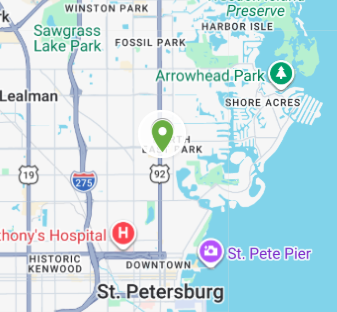
3637 4th St N, St. Petersburg, FL 33704
-
We are at 3637 4th St N, St. Petersburg, FL 33704, on 4th Street North in central St. Petersburg. Patients come in from across St. Petersburg, from Pinellas County and from Tampa Bay generally. Call or text (727) 498-6027 if you want directions or want to check the schedule before you come in.
-
Often, yes. Same-day appointment availability is something we protect on purpose, because sports injuries tend to happen outside office hours and the first few days are when the decisions matter most. Call or text (727) 498-6027 and the front desk will run through what is still open.
If your symptoms suggest something urgent, such as an inability to bear weight, a joint that gave way, obvious deformity, progressive weakness in an arm or leg, or any new bowel or bladder changes or numbness through the groin or inner thighs, tell us when you call so we can direct you appropriately. Those cases belong in an emergency setting or with a specialist first, and we will say so.
-
First, the findings that skip the appointment entirely and need emergency care the same day: a limb that is visibly deformed or will not hold any weight at all, a joint that has gone unstable since the injury, swelling that keeps building hard and tight in the hours after a blow to a muscle, or a sudden loss of strength and sensation below the injury.
Past that, it is a question the examination answers, not one you should have to answer yourself before booking. Certain findings push toward imaging or a surgical opinion: an inability to put weight on a limb, a joint that feels unstable or gives way, a mechanism that suggests a fracture, a muscle or tendon that may have fully ruptured, a significant loss of strength, or symptoms that are not improving at all on a reasonable timeline. Dr. Raad tests for those specifically rather than assuming.
If the exam points that direction, he refers you for the appropriate imaging or specialist consult. Dr. Raad is a Doctor of Chiropractic, not a surgeon, and he is clear with patients about where that line sits.
-
There are useful rules, and you will leave with the version specific to your injury. Broadly: pain that warms up and stays gone, stays at a low level, and does not leave you worse the next morning is often load you can tolerate. Pain that climbs during activity, that makes you change how you move, that is worse the following morning than it was before you trained, or that comes with swelling, instability, numbness or weakness is not pain to push through. Sharp pain at a specific point on a tendon or bone is also a stop signal, not a warm-up issue. The reason this matters is that the wrong call made repeatedly is how a short problem becomes a long one.
-
Because recurrence is a sign that the original problem was never fully identified or never fully rehabilitated. Three causes come up again and again. The injury was treated until it stopped hurting rather than until the tissue regained its strength and capacity, so it failed again at the same load. The real driver was somewhere else, such as a restricted hip or ankle loading the injured tissue harder than it should, and that was never addressed. Or the return to training skipped the middle, going from rest straight back to competition intensity. A recurring injury is worth a proper examination precisely because the answer is often in something that has not been looked at yet. We treat it as a new diagnostic question, not as a repeat of last year's plan.