

Whiplash Treatment in St. Petersburg, FL
Whiplash Treatment Built on an Exam That Tests the Neck Before Anything Is Treated
5-Star Rated | Same-Day Visits | Whiplash Injury Exams
Auto Accident New Patient Offer
Free Auto Injury Consultation + Treatment With $0 Out-Of-Pocket For Eligible Patients
Why Choose Us
Why whiplash patients trust ELITE CHIROCARE


Every treatment decision follows a full cervical exam, never an assumption
Your plan shifts as the neck leaves the acute stage and can tolerate mobility work
Guidance on sleep position and desk setup, because an irritated neck flares at home
Dry needling and shockwave therapy offered for deep cervical muscle guarding
State of the art equipment and modern techniques for cervical spine care
Same-day appointment availability when whiplash symptoms have just started
A verified 5-star Google rating from real local patients
No pressure to commit to a long-term plan
A central St. Petersburg office on 4th Street North, short drive, short wait
Cervical findings documented with measurements, and billing coded to the visit

What We Offer
What we treat in whiplash and cervical soft tissue injury
Whiplash associated disorder from rear-end, side-impact, and low-speed collisions
Delayed-onset neck pain and stiffness that appears one to three days after the crash
Cervical sprain and strain involving the ligaments and deep stabilizing muscles
Reduced neck rotation, including difficulty checking blind spots while driving
Cervicogenic headaches that begin at the base of the skull and wrap forward
Jaw pain, clicking, and tightness following the head's forward and backward snap
Shoulder, shoulder blade, and upper arm pain referred from the cervical joints
Numbness, tingling, or weakness in the arm or hand from nerve root irritation
Disrupted sleep and the morning stiffness that follows a night of guarding
Screening for dizziness, vision changes, and concentration trouble, with referral when indicated
Chiropractic adjustment of the cervical and upper thoracic spine, matched to the stage of healing
Deep cervical muscle guarding addressed with dry needling and shockwave therapy
Manual and soft tissue therapy for the scalenes, levator scapulae, and suboccipital muscles
Progressive deep neck flexor and postural retraining to rebuild head and neck endurance
Meet your chiropractor
Dr. Raad, DC, MBA, MA

Dr. Raad has treated whiplash for years, and his view of it is shaped by how routinely the injury gets waved off. The mechanism is violent in a way the damage does not advertise. In a collision the seat drives the torso forward while the head lags for a fraction of a second, then snaps through a range the neck muscles never had time to brace for. Ligaments are loaded past their working range, the deep stabilizing muscles are strained, and the small facet joints at the back of the neck are compressed and irritated. A patient can walk away from that, feel reasonably fine, and still have a real injury. What decides how a whiplash case ends is not how aggressive the treatment was. It is how accurate the thinking behind it was.
He will not accept "neck pain" as a diagnosis. Pain at the base of the skull that climbs into the head is a different problem from pain between the shoulder blades, which is different again from pain that runs down an arm, and the three call for different responses. Treating the wrong one is not a neutral mistake. It spends the weeks when an acute cervical injury responds best. So the examination comes first, it is deliberate, and Dr. Raad is willing to finish it by saying he wants a clearer picture before committing to a plan. He refers you for imaging when the findings warrant it rather than treating around a question he has not answered.
The harder part comes later in a course of care. Whiplash rarely improves in a straight line, and an approach that produced change in week two can quietly stop producing any, and that only shows up if someone is measuring for it, which is why Dr. Raad re-examines on a set schedule. He puts his own working diagnosis back under question when the numbers go flat, and changes the approach rather than the volume. When a case points somewhere outside what belongs in this office, he says so and coordinates the referral.
There is also the problem that whiplash is largely invisible, which is harder on the patient than it sounds. People are often told the films are clean and left with pain nobody has explained to them, and the natural response is to brace, hold still, and assume quietly that something serious is being missed. Dr. Raad treats the explanation as part of the care. You should be able to describe your own injury accurately: what was strained, why it refers where it does, what belongs in a normal recovery and what does not.
His credentials are a Doctor of Chiropractic along with an MBA and an MA. He treats whiplash and crash-related cervical injuries at Elite ChiroCare & Injury Recovery in central St. Petersburg, using state of the art equipment and modern techniques. The practice holds a verified 5-star Google rating from real local patients. These cases often arrive with an open insurance claim attached, so the record has to hold up to readers outside this office. He writes it accordingly: cervical measurements taken on the date they are taken, billing coded to what was actually delivered, and direct contact with whoever else is treating you.
PATIENT Reviews



Our Approach
Testing the Neck One Structure at a Time
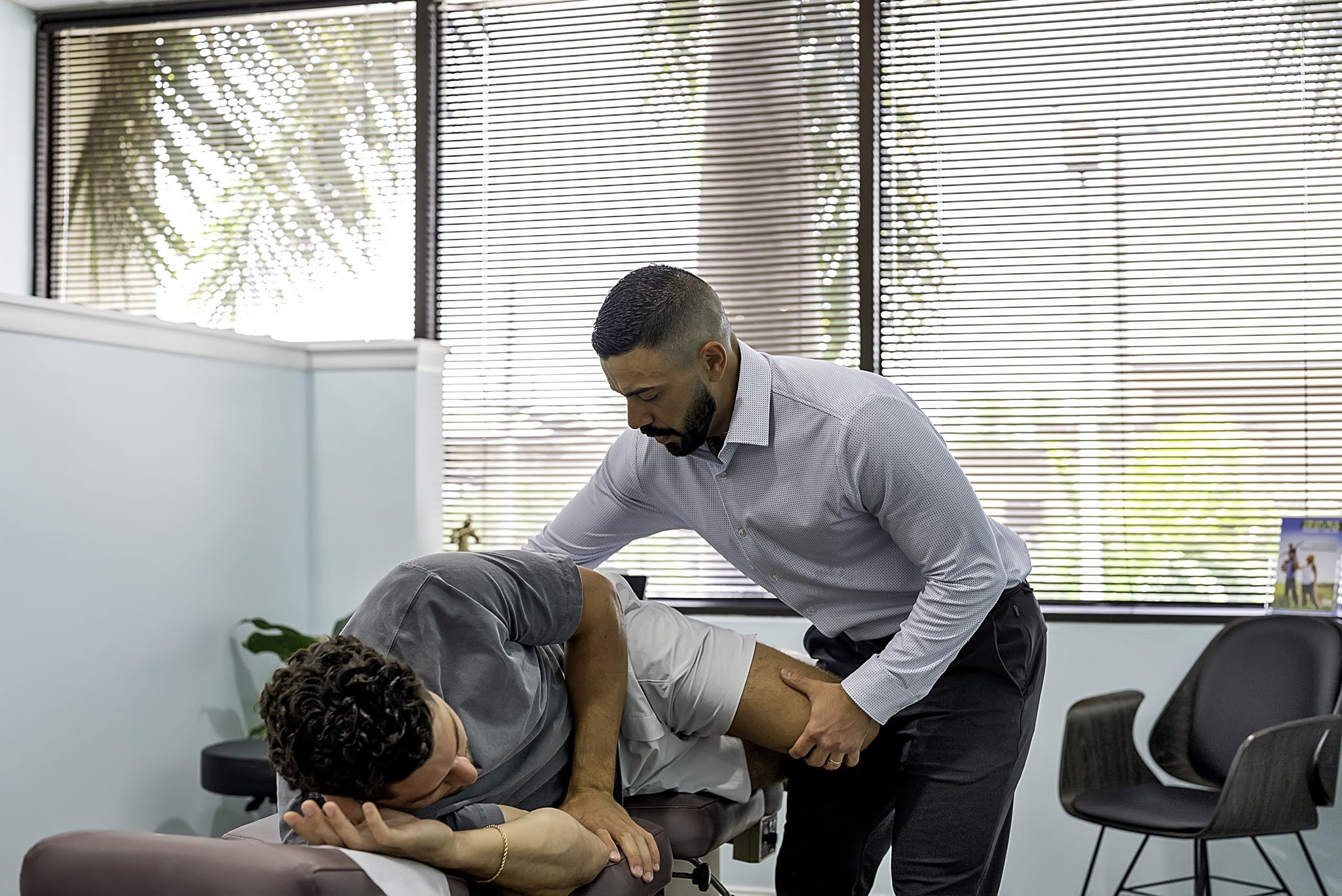
The examination is the longest part of a first visit here. Dr. Raad measures rotation, flexion, extension, and side bending, and records where each one stops and what stops it. He palpates segment by segment to find the joints that are genuinely restricted rather than generally sore, screens the nerve roots for changes in sensation, strength, and reflex, and checks for signs of gross instability that would change the plan or send you out for imaging first. He examines the jaw, the upper back, and the shoulder girdle as well, because the head's forward and backward snap loads all three. What comes out of that is a set of specific findings with measurements attached, which is what makes a treatment plan specific and what your record needs to contain.

The Stages a Neck Moves Through
Whiplash moves through stages and the right treatment changes with them. In the early window, inflamed and guarded tissue needs low-force work, and a neck pushed hard in that state tends to tighten further. Once the acute phase settles, the limiting factor is often stiffness and protective holding, so the mobility and soft tissue work that would have been too much at the start becomes the main event. Later the gap is often endurance in the deep neck flexors, which is why some people feel fine in the morning and sore by mid-afternoon. Dr. Raad re-measures at each visit and treats what the neck is doing now. Because the plan follows your findings, there is no pressure to commit to a long-term schedule.

The Twenty-Three Hours You Are Not Here
Sleep gets addressed first. A pillow that holds the neck at the end of its range for eight hours will undo a good visit, so Dr. Raad works out height and position with you before much else. Then the daytime load: monitor height, how long you sit in one posture, how much of the day goes to looking down at a phone. Movement is part of the plan from early on, because a neck held rigid all day stays stiff, so you leave with a tolerable range to move through. The home program is short and specific, a handful of exercises with the reason each one is on the list, plus a plain answer about what to hold off on and when you can expect to pick it back up.

Whiplash Treatment in St. Petersburg, FL
Whiplash happens when the head is thrown through a range of motion faster than the neck can brace against it. The obvious reading is a muscle problem that loosens up on its own, and for some people it does. Often it is more than that. The ligaments holding the cervical vertebrae get loaded past their working range, the deep stabilizing muscles are strained, and the facet joints at the back of the neck are inflamed. Whiplash also gets underestimated because it frequently does not present as neck pain at all. It shows up as headaches at the base of the skull, as jaw tightness or clicking, as a deep ache between the shoulder blades, or as tingling in a hand, and patients describe those symptoms without connecting them to the collision.
The hardest part of a whiplash case is often the gap between the crash and the first appointment, because symptoms tend to surface a day or two later and the decision about getting examined gets made while nothing hurts much yet. Florida's no-fault system generally requires evaluation by a licensed provider within 14 days of a crash to preserve personal injury protection benefits, and a neck that only starts hurting on day three can spend a meaningful part of that window before anyone has looked at it. There is a clinical reason to move early too. An acute cervical sprain is easier to treat before the surrounding muscles have spent weeks holding the area still. An early exam also dates the injury in your record, worth having whether or not a claim is eventually filed.
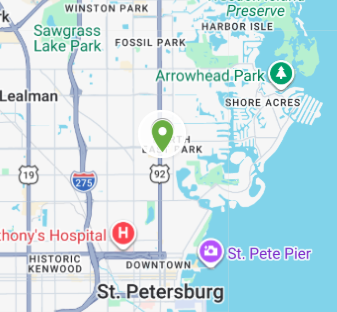
Whiplash and crash-related cervical injuries are treated at 3637 4th St N, St. Petersburg, FL 33704. Pinellas County drivers get here easily, and so do the ones coming from the Tampa Bay side. Same-day appointment availability matters on this injury because of how it arrives. Symptoms surface two or three days after the collision, which is already inside the fourteen day window, and often while the patient is still deciding whether what they are feeling is worth a visit. If your neck, head, jaw, or shoulders have been bothering you since a crash, whether that was yesterday or ten days ago, book the auto accident new patient visit online, or call or text (727) 498-6027.
Frequently Asked Questions
3637 4th St N, St. Petersburg, FL 33704
-
Look for 3637 4th St N, St. Petersburg, FL 33704. It is a central city address, and whiplash patients make the trip from all over St. Petersburg, from the rest of Pinellas County, and from around the wider Tampa Bay area. Call or text (727) 498-6027 if you need directions.
-
There is a real chance of it. Same-day appointment availability is held open for recent injuries, and whiplash makes the clearest case for using it, because the symptoms commonly build over the first few days. Call or text (727) 498-6027 and ask for the first available whiplash evaluation.
-
That is a common pattern after a collision. Adrenaline suppresses pain in the minutes and hours immediately afterward, and the inflammatory response to strained ligaments and deep muscle tissue takes roughly twenty-four to seventy-two hours to build. So the stiffness, the headaches, and the restricted rotation tend to surface on day two or day three. Delayed onset does not mean the injury is minor. It means you were not able to feel it yet. If symptoms have just started, that is a reason to be examined now.
-
One thing before the timeline, because it does not wait for one. A headache unlike any you have had, a neck that will not move at all alongside severe pain, difficulty swallowing or speaking, new double vision, weakness or numbness in an arm that is visibly getting worse by the day, new bowel or bladder changes, or numbness through the groin or saddle area all need emergency care the same day, not an appointment.
On the question itself: for a straightforward cervical sprain treated early, improvement often comes over roughly six to twelve weeks, with the first noticeable change often inside the first two or three weeks. Cases involving nerve root irritation, or ones that went months without care, take longer, because the guarding and compensation that built up have to be unwound along with the original injury. Dr. Raad will tell you what he found, give you a realistic expectation based on it, and reassess as you go rather than locking you into a fixed number of visits.
-
Because X-rays image bone, and whiplash is an injury to ligaments, deep stabilizing muscles, and small spinal joints. A normal X-ray is useful information, it rules out fracture and dislocation, but it cannot see the tissue that whiplash damages. A hands-on examination is what identifies that: measuring where your range of motion stops, testing ligament stability, finding which specific segments are restricted, and checking whether the nerve roots are involved. That is the exam Dr. Raad performs.